Safety · Guide
Is mobile IV therapy safe in Istanbul? An honest guide for visitors
5 min read

It is a sensible question to ask before anyone places a cannula in your arm in a hotel suite or on the deck of a yacht. The honest answer is that a drip given by trained people, with proper checks, carries small and well-understood risks. The difference between a calm hour and a poor experience lies almost entirely in how the provider works. This guide sets out what can go wrong, what good practice looks like, and how to tell the two apart before you book anyone at all.
The short answer
For a healthy adult, an intravenous drip of fluids and vitamins is a low-risk procedure. Hospitals around the world give millions of them every day. Moving the same procedure into a hotel room does not make it dangerous, but it does remove the safety net of a ward, which is why the habits of the people involved matter so much.
IV therapy is a wellness service. It may help you feel rehydrated after a long flight, a late night or a warm day in the city. It is not emergency care, and no responsible provider will present it as a cure for anything.
The real risks, in proportion
The most common side effect is simply a bruise where the needle went in, sometimes with mild tenderness for a day or two. Some people feel a cool sensation travelling up the arm, or a brief taste of vitamins in the mouth. Less often the vein becomes irritated and slightly sore; a warm compress usually settles it.
Rarer, and more serious, are infection at the insertion site, which careful hygiene and single-use equipment keep very unlikely, and an allergic reaction to an ingredient, which is why a nurse should stay with you and carry the right medicines. Finally, extra fluid can strain the body of someone with heart failure or kidney disease. For these guests a drip is usually not appropriate at all, and a proper health questionnaire exists to catch exactly that.
What good practice looks like
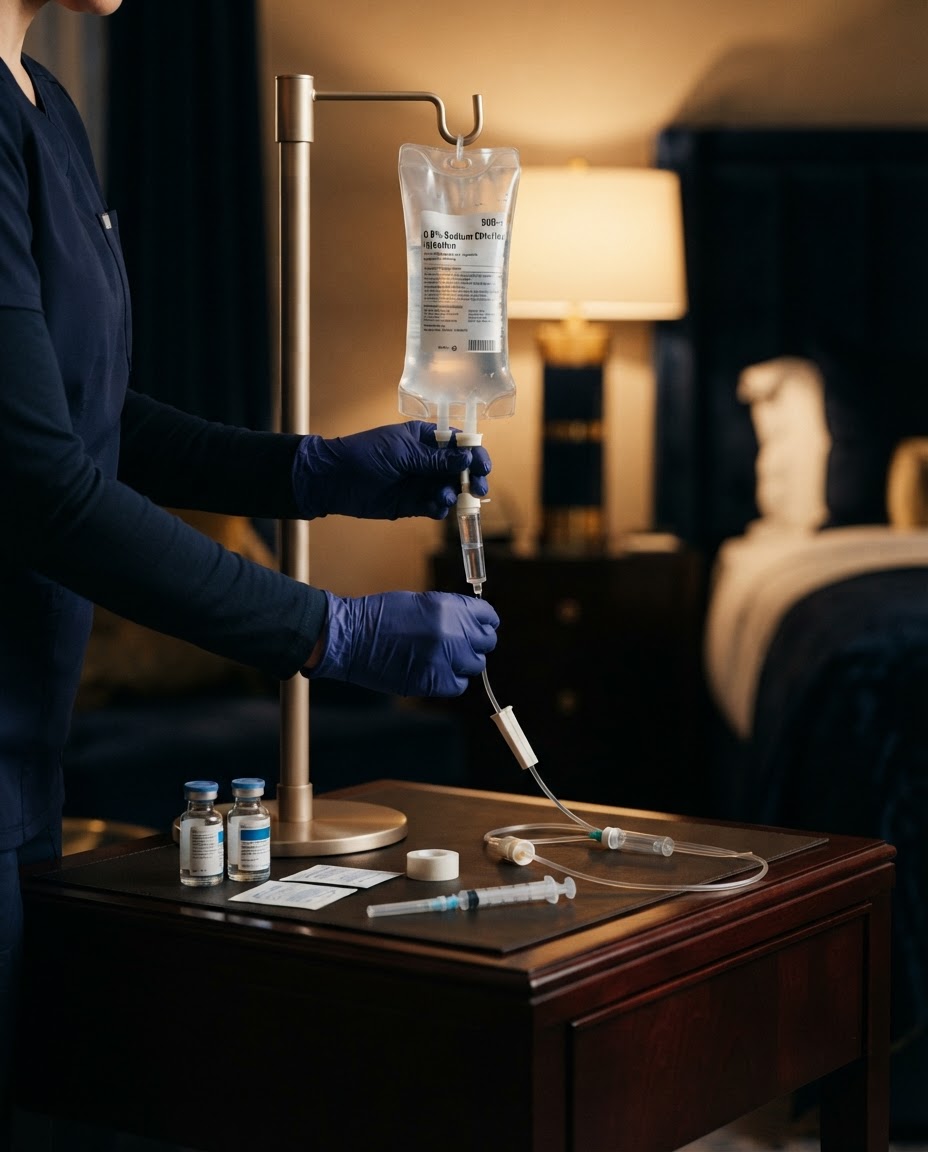
Before the visit, a doctor reads your answers to a short health questionnaire and approves, adjusts or declines the booking. On the day, a licensed nurse places the line, checks your blood pressure, pulse and oxygen before starting, and watches them again during the infusion.
Ingredients should be sealed, pharmaceutical-grade products from licensed suppliers, opened in front of you, with labels you can read. Needles, cannulas and tubing should be single-use. An emergency kit should be in the bag on every visit, and the nurse should stay beside you from the first drop to the last, with a doctor reachable by phone throughout.
Questions to ask any provider before booking
A good provider will answer these calmly and without hesitation. Ask them of anyone, including us.
- Who reviews my health answers before the visit, and is it a doctor?
- Who will insert the line, and are they a licensed nurse?
- Where do the ingredients come from, and will I see them sealed?
- What happens if I have a reaction, and what is in your emergency kit?
- Will the nurse stay for the whole infusion?
- Would you ever say no to a booking, and if so, when?
Red flags worth walking away from
Be cautious if nobody asks about your health, medicines or allergies before agreeing to come. The same applies if the nurse plans to set up the drip and leave, or if the bags arrive unlabelled or already mixed.
Promises are another tell. A drip that claims to "detox" your liver, cure a hangover outright or treat an illness is selling a story, not a service. And a price far below the rest of the market usually means something has been removed: the doctor, the quality of the ingredients, or the time the nurse spends with you.
When to call 112 instead
Some situations need an ambulance, not a drip. Call 112, the emergency number in Turkey, for chest pain, difficulty breathing, fainting, confusion, a severe allergic reaction, heavy bleeding, signs of a stroke, or anyone who is too intoxicated to answer questions clearly. A drip in these moments only delays the care that is needed.
How Bosphorus Drip approaches it
At Bosphorus Drip every booking begins with a questionnaire on WhatsApp, and a doctor reviews each one. If the doctor declines, there is no charge. A licensed nurse arrives with sealed, single-use ingredients and an emergency kit, checks your vital signs, and stays for the whole infusion. If the answers to the questions above matter to you, we are glad to go through them before you decide.
Questions
Is it safe to have an IV drip in my hotel room in Istanbul?
For a healthy adult, yes, when a doctor reviews your health answers first and a licensed nurse stays with you, checks your vital signs and uses sealed, single-use supplies.
Who should not have IV therapy?
People with heart failure or serious heart disease, kidney disease, a known allergy to an ingredient, anyone under 18, and pregnant or breastfeeding women without their own doctor’s approval.
What are the most common side effects?
A small bruise or mild tenderness where the needle went in, a cool feeling in the arm, or a brief vitamin taste. These usually pass within hours or a day or two.
What if I feel unwell during the drip?
The nurse can slow or stop the infusion at once and carries an emergency kit, with a doctor reachable by phone. For chest pain or breathing difficulty, 112 is called straight away.
This article is general information, not medical advice. A doctor reviews every booking. In an emergency, call 112.